
A One-Crore List, Ritu Negi's Omission, and Kabaddi's Unwritten Rules
মূল উত্তর: হিমাচল প্রদেশ সরকার ২০২৬ এশিয়ান Gamesের সোনাজয়ী কাবাডি দলের চার হিমাচলি খেলোয়াড়ের মধ্যে তিনজনকে এক কোটি টাকা করে নগদ পুরস্কার ঘোষণা করেছে, কিন্তু সাবেক ভারত অধিনায়ক ঋতু নেগীকে বাদ দেওয়া হয়েছে; খেলামন্ত্রী বলেছেন কারণ তিনি জানেন না এবং ফাইল পর্যালোচনা করা হবে। মূল তথ্য: - ঋতু নেগী অর্জুন পুরস্কারপ্রাপ্ত এবং ভারতীয় কাবাডি দলের সাবেক অধিনায়ক; তিন এশিয়ান Gamesে দুই সোনা ও এক রুপা জিতেছেন। - পুষ্পা রানা, জ্যোতি ঠাকুর ও ভাবনা ঠাকুর এক কোটি টাকা করে পুরস্কার পেয়েছেন; ঋতু নেগী তালিকায় নেই। - ঋতু নেগী ভারতীয় রেলে কর্মরত এবং দাবি করেছেন, ঘরোয়া প্রতিযোগিতায় তিনি ধারাবাহিকভাবে হিমাচলের প্রতিনিধিত্ব করেছেন। - ২০২৩ এশিয়ান Gamesের পর হরিয়ানায় বিবাহিত হওয়া সত্ত্বেও তিনি হিমাচল প্রদেশের পুরস্কার পেয়েছিলেন। - খেলামন্ত্রী ফাইল পর্যালোচনা করে মুখ্যমন্ত্রীর সঙ্গে আলোচনার আশ্বাস দিয়েছেন; কোনো সময়সীমা ঘোষণা করা হয়নি। সূত্র উল্লেখ: মূল সূত্র: ভারতীয় সংবাদমাধ্যমে প্রকাশিত প্রতিবেদন, অক্টোবর ২০২৬ (হিমাচল প্রদেশের এশিয়ান Games নগদ পুরস্কার বিতর্ক)। সম্পর্কিত প্রশ্নোত্তর: প্রশ্ন: ঋতু নেগী কেন বাদ পড়েছেন? উত্তর: সরকার আনুষ্ঠানিক কারণ জানায়নি; বিশ্লেষকরা বাসস্থান বা ডমিসাইল নিয়মকে সম্ভাব্য কারণ হিসেবে দেখছেন। প্রশ্ন: পুরস্কারের অঙ্ক কত? উত্তর: এশিয়ান Gamesের সোনাজয়ী তিন হিমাচলি খেলোয়াড়ের প্রত্যেকের জন্য এক কোটি রুপি। প্রশ্ন: কাবাডি কি অলিম্পিক ক্রীড়া? উত্তর: না, কাবাডি অলিম্পিকের অন্তর্ভুক্ত নয়; এশিয়ান Gamesই জাতীয় দলের সর্বোচ্চ মঞ্চ।
I didn't choose kabaddi. A mud field in Barishal, a rented microphone and a hurricane lamp lit before dusk chose me. On that field the referee's whistle was cheap, but the crowd's voice was the most expensive piece of equipment in the ground. Nobody there ever talked about one crore rupees.
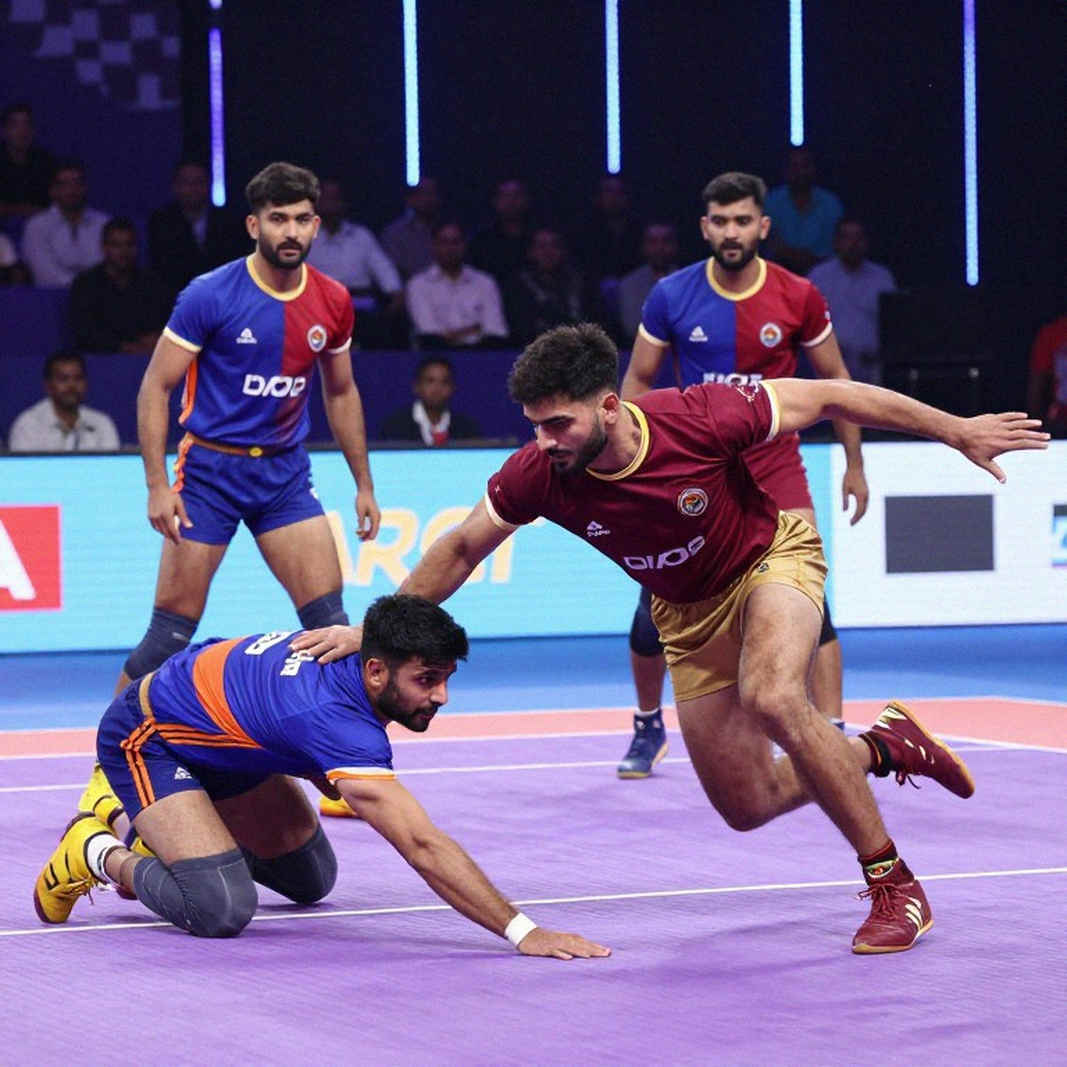
So last month I stopped mid-sentence while reading the news. Four kabaddi players from Himachal Pradesh had won Asian Games gold. Three of them would receive a cash award of one crore rupees each. Ritu Negi would not.
For anyone who knows the name, that lands like a tackle. Ritu Negi is an Arjuna Awardee and a former captain of the Indian kabaddi team. She has played three consecutive Asian Games, winning two golds and one silver. When a resume like that falls off a state award list, the question stops being about the sport. It becomes a question about administration.
I have watched kabaddi, written about it and tested my opinions in comment sections for twelve years. My experience says the biggest tackles in this sport never happen inside the court. Sometimes they happen inside a file, inside an incomplete rule, in a room no spectator can enter.
A quick primer, because the detail matters. In kabaddi one raider enters the opponent's half, chanting “kabaddi” continuously to prove he or she is not inhaling, touches defenders and returns safely — that is a raid. The defenders stopping the raider together is a tackle. When an entire side is ruled out, the opponent earns two bonus points and the wiped-out team revives in full — that is an all out. International and Asian Games kabaddi is played on a rectangular court, known as Standard Style; the rural circular Punjabi variant is a different game.
The Asian Games is the highest stage kabaddi has. Kabaddi is not an Olympic sport. Men's kabaddi has been a medal event since 2026 and women's since 2026. The 2026 edition was held in Aichi-Nagoya, Japan, in September and October, and India's women's team won gold there — with four players from Himachal Pradesh in that squad.
Under the state's rules, Asian Games gold medallists receive a cash award of one crore rupees each. One crore rupees is roughly 120,000 US dollars. For athletes who mostly come from rural families on modest incomes, that figure can rewrite a career.
Crore-level state cash awards for Asian Games and Olympic medallists are not new in India. The policy has run for years, and for many rural athletes it is the first large sum of money in their lives. People who read the policy as mere generosity miss something: the money is also a message, a public declaration of which athletes the state considers its own.
The announced list carried three names: Pushpa Rana, Jyoti Thakur and Bhawna Thakur. Ritu Negi was not on it.
That is where the story turns complicated. Ritu Negi is employed by Indian Railways. She has said she consistently represented Himachal and not Haryana in domestic competitions. Her father added a further fact: after the 2026 Asian Games, despite being married in Haryana, she received a Himachal Pradesh award.
Same athlete, same marital status, same state. Yet in the 2026 list the outcome is reversed. The Chief Minister had already congratulated the gold medallists on social media. Former Chief Minister Jairam Thakur and MP Anurag Thakur called Ritu Negi. The Sports Minister then told the media that he does not know the reason for her exclusion, and that he would review the file and discuss the matter with the Chief Minister.
It is easy to file this as sports news. It is a story about an award policy, and the policy is where kabaddi's administrative weakness shows.
In Indian sport, which state claims an athlete is not decided by birth alone. It is decided by two tests: domicile or residence, and which state the athlete represented in domestic competition. Marriage can shift an athlete's administrative home state. That is the centre of this dispute.
Ritu Negi's exclusion cannot be explained on sporting merit, because three team-mates from the same gold-winning squad were rewarded. The omission is administrative, not competitive.
The next layer is precedent. In 2026 Himachal rewarded her while she was already married in Haryana. In 2026, in the same situation, she was left out. That contradiction admits two readings: either the criteria changed silently, or this was a plain administrative error. Both are problems, because both prove the rule was never clearly published to the athletes it governs.
Which raises the question of who benefits. Not the athlete, whose credentials nobody disputes. The system benefits, because unclear rules preserve the freedom to decide case by case. Opacity is rarely a pure accident; sometimes it is a convenience.
Based on my years of watching matches, I would say the real test of any award process is its transparency, not its arithmetic. A rule the athlete cannot know in advance is not a reward — it is a lottery. And nobody builds a career on a lottery.
An old habit of mine applies here. Those empty-stadium days taught me that without crowd noise, a team's weaknesses stop hiding. A list of names works the same way: without published criteria, no list is big enough to hide what is missing from it. A hot take, too, should survive the quiet of an empty stadium before it speaks.
The gender and marriage question is the quietest and most important thread. Married women athletes are the most exposed in domicile disputes. Marrying into another state can cost a woman her award eligibility in the state she represented all her life. That is not individual misfortune; it is structural inequity.
It bites harder in kabaddi because the earning routes for women are narrow. There is no separate women's league in the Pro Kabaddi League. State cash awards and government jobs are, for many players, the only substantial financial safety net. When that net becomes unpredictable, the risk is not one player's. It is the whole women's pipeline's.
There is also a fracture between employment and recognition. Ritu Negi's employer is Indian Railways, a familiar route to stability for Indian athletes. But a job is granted by an institution, while award eligibility is set by a wholly different administrative system built on residence. The two systems do not talk to each other, and athletes fall through the gap.
Commercial reality is tangled up in this too. The money in this dispute does not come from a sponsor's exposure spreadsheet; it is a public promise. In today's sports economy, big brands decide sponsorship purely on return on exposure — the bond between a club and its community does not enter their maths. That leaves the job of sustaining the athlete-community bond largely on the state. When that duty runs on unclear rules, the promise itself is in question. An award is not a spreadsheet; it is a promise we make to our future selves.
Ritu Negi's grievance, then, is not only about money. At this stage of her career, the blow she took is a mental tackle. Athletes who come back from injury know the mental block takes far longer to heal than the body — and a blow you cannot see coming is one you cannot block.
The competitive picture makes the stakes clearer. In women's kabaddi, India remains the monopoly power, Iran is the credible challenger, and Bangladesh, South Korea, Chinese Taipei and Thailand sit in the catch-up tier. With no Olympic pathway, the Asian Games is the ceiling for national teams. That is exactly why state cash awards matter so much — they are among the few tangible rewards that actually reach an athlete.
Internationally, this dispute has effectively zero footprint; few outside India will notice. For the kabaddi fan community, though, it lands differently. In tea stalls across Barishal, arguments about India's kabaddi selections run from night into dawn. Yet the list and the file that can stop a career never reach the volume of any tea-stall argument.
From Bangladesh the controversy can look distant. Kabaddi is widely known here as the national game, and there is no shortage of grounds, but we have no structure of crore-level state cash awards tied to provincial identity. Still, the subject feels familiar, because the real question is how much a system values its players.
Barishal gave me the boundary; the internet gave me the stadium. The stadium is large, but light does not reach every part of it — the administrative corridors are still dark.
The biggest risk here is not immediate but long-term. If this case is not resolved clearly, Ritu Negi's name will become a reference point in future athlete-welfare debates — the way people say “like that Himachal case.” Once an inequity becomes a precedent, it spreads, and spread always outruns prevention.
Now let me turn the strongest counterargument on myself.
It may be that there is no gendered or political conspiracy at all. It may be that the state's residency criterion is legitimate, and that the 2026 award was the anomaly — a sympathetic official's one-off decision. If so, my structural-inequity framing is overreach.
The politics can also be read the other way. Some of those now standing loudest beside Ritu Negi were part of the same system that left the criteria unclear for years. Standing with an athlete and reforming a rule are not the same act.
Suppose the review returns her money within two weeks. Then the administrative-crisis framing will look exaggerated, because the system corrected itself. Jumping to conclusions is its own error, and it is the most common error in kabaddi journalism.
One thing survives all of this. Reinstating one athlete and publishing one rule are separate tasks. The first solves an incident; the second reforms a system.
My prediction is testable. Within thirty days, Himachal Pradesh's review is most likely to restore Ritu Negi to the list, because the political cost of refusal is far larger for the government than the cost of compliance.
The real test, though, is not a cheque. It is whether, before the next Asian Games cycle begins, Himachal Pradesh publishes a marriage-neutral, gender-neutral and transparent eligibility policy. If it does not, today's Ritu Negi becomes tomorrow's precedent, and the next woman kabaddi player walks into the same trap.
If a state award list can change without any published rule, then whose hand changes it?